The Invisible Building Blocks: Introducing the Enigma of Quarks
For centuries, humanity has sought to understand the fundamental constituents of matter. From ancient philosophies proposing earth, air, fire, and water, to the discovery of atoms, then protons, neutrons, and electrons, our journey into the microscopic has continually refined our understanding. Yet, deep within the heart of every atomic nucleus lies an even more profound mystery: particles so fundamental, so inextricably linked, that they can never be observed in isolation. These are quarks. When we
define quark, we're talking about the very bedrock of the universe, and their peculiar nature challenges our everyday intuition about particles.
The true enigma of quarks isn't just their tiny size or their exotic properties, but the extraordinary fact that, despite making up protons and neutrons—the very stuff of all observable matter—they refuse to exist alone. This article will delve into what quarks are, explore their fascinating characteristics, and ultimately unravel the scientific phenomenon known as "color confinement" that explains why these fundamental particles are always found in tightly bound groups.
What Exactly is a Quark? Unpacking the Fundamentals
At its core, a quark is an
elementary particle and a fundamental constituent of matter. Unlike composite particles like protons and neutrons, which are made of quarks, quarks themselves are thought to have no discernible substructure. They are truly fundamental, existing at the deepest level of reality we currently understand.
The Standard Model of particle physics, our most successful theory describing the fundamental forces and particles, identifies six different types, or "flavors," of quarks, along with their corresponding antiquarks:
- Up Quark (u): Carries an electric charge of +2/3.
- Down Quark (d): Carries an electric charge of -1/3.
- Strange Quark (s): Carries an electric charge of -1/3.
- Charm Quark (c): Carries an electric charge of +2/3.
- Bottom Quark (b): Carries an electric charge of -1/3.
- Top Quark (t): Carries an electric charge of +2/3.
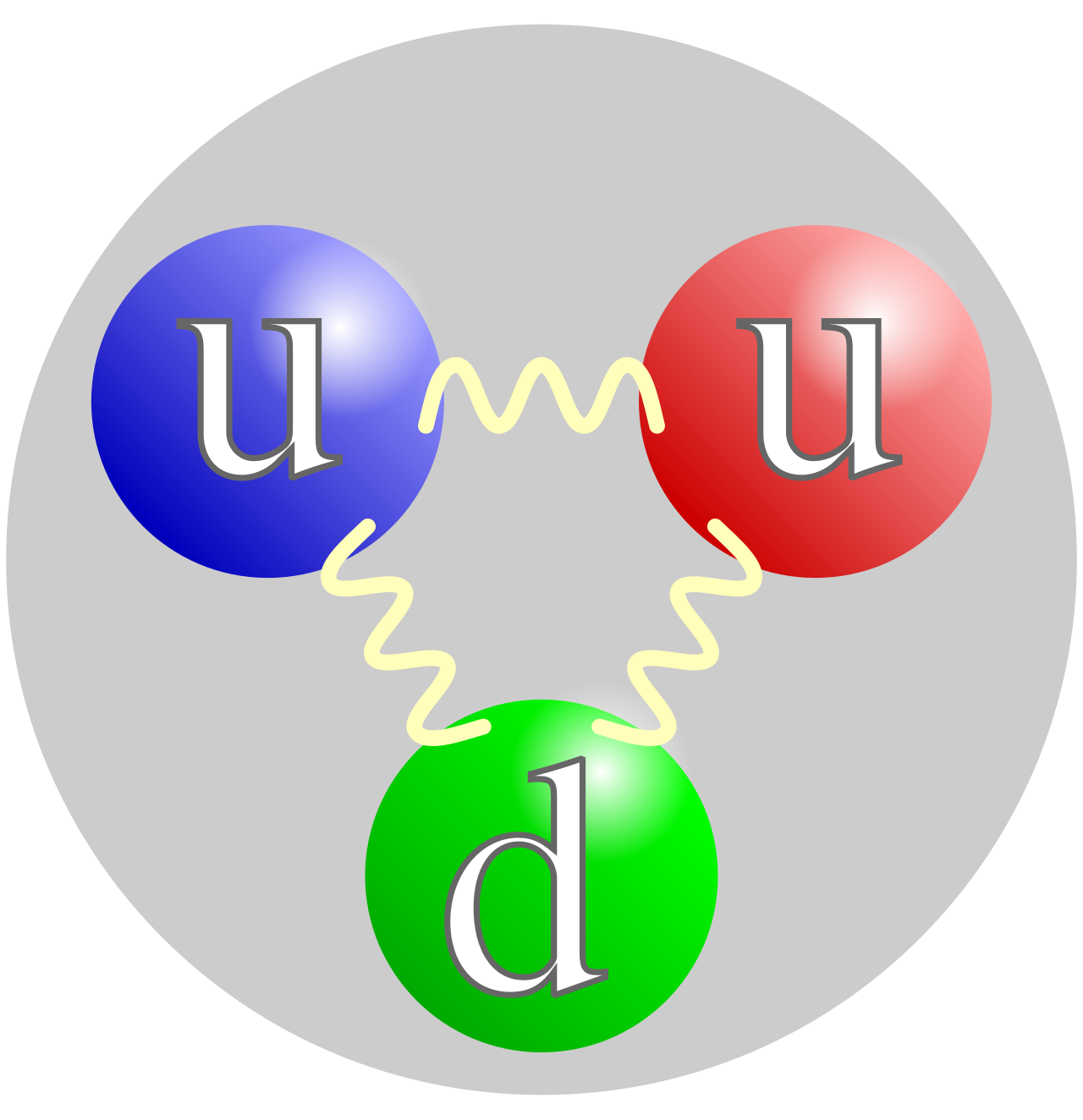
The up and down quarks are the lightest and most stable of all quarks, forming the bulk of everyday matter. Protons, for instance, are composed of two up quarks and one down quark (uud), giving them a net charge of (+2/3 + 2/3 - 1/3) = +1. Neutrons consist of one up quark and two down quarks (udd), resulting in a net charge of (+2/3 - 1/3 - 1/3) = 0.
While quarks have not been "seen" directly in the way we might observe an electron or a larger particle, theoretical predictions based on their existence have been repeatedly and overwhelmingly confirmed through high-energy experimental data. The concept of quarks, first proposed in the 1960s, revolutionized our understanding of the atomic nucleus, providing an elegant solution to the complex puzzle of subatomic particles.
The Colorful World of Quarks: Beyond Flavors and Charge
Beyond their flavor and electric charge, quarks possess another peculiar property known as "color charge." This isn't literal color in the visual spectrum, but rather an abstract quantum property that plays a crucial role in how quarks interact. Just as electric charge dictates electromagnetic interactions, color charge dictates the strength of the
strong nuclear force, the most powerful of the four fundamental forces.
There are three "colors" of charge for quarks, typically labeled red, green, and blue, as an analogy to primary colors. Each antiquark carries an "anticolor" (anti-red, anti-green, anti-blue). This analogy is particularly apt because, much like combining red, green, and blue light produces white light, quarks must combine in such a way that their overall color charge is "neutral" or "white."
The strong nuclear force, mediated by particles called
gluons, binds quarks together. Gluons themselves also carry color charge, allowing them to interact not only with quarks but also with each other, making the strong force incredibly complex and powerful. For any composite particle made of quarks to exist stably, its total color charge must be neutral. This is why:
- Baryons (like protons and neutrons) are composed of three quarks, each carrying a different color (red + green + blue = white).
- Mesons are composed of a quark-antiquark pair, where the quark has a specific color and the antiquark has the corresponding anticolor (e.g., red + anti-red = white).
This "color neutrality" requirement is a fundamental principle of quark interactions and is directly responsible for their unique confinement. To learn more about the specific combinations and implications of these particles, explore
Quarks Explained: From Six Flavors to Protons and Neutrons.
The Phenomenon of Color Confinement: Why Isolation is Impossible
Now we arrive at the heart of the mystery: why are quarks never found in isolation? The answer lies in the extraordinary behavior of the strong nuclear force, governed by the principle of
color confinement.
Unlike other fundamental forces, such as electromagnetism or gravity, which weaken with distance, the strong force behaves in precisely the opposite way. When quarks are close together within a hadron (like a proton), the strong force binding them is relatively weak, allowing them to move almost freely—a phenomenon known as "asymptotic freedom." However, if you try to pull two quarks apart, the strong force between them doesn't weaken; instead, it grows incredibly stronger, much like stretching an immensely powerful, invisible rubber band.
Imagine trying to separate a quark from its companions. As you apply more and more energy to pull them apart, the force holding them together increases linearly with distance. This immense amount of energy eventually becomes so great that it exceeds the energy required to create new quark-antiquark pairs from the vacuum itself. Instead of isolating a single quark, the energy you inject simply creates new hadrons (mesons or baryons).
This process can be visualized as breaking a magnet: you don't get a north pole separated from a south pole; you get two smaller magnets, each with its own north and south pole. Similarly, when you attempt to isolate a quark, the "stretched" gluon field snaps, and the energy released forms new quark-antiquark pairs, which immediately combine to form new, color-neutral particles. What you observe in particle accelerators, for instance, are "jets" of new hadrons, not individual quarks. This experimental evidence strongly supports the theory of color confinement.
Hadrons: Quarks' Preferred Social Clubs
Because of color confinement, quarks are only ever found within composite particles called hadrons. These are essentially the "social clubs" where quarks can fulfill the requirement of color neutrality. As mentioned, the two main types of hadrons are:
- Baryons: Composed of three quarks. Protons (uud) and neutrons (udd) are the most common and stable baryons, forming the nuclei of all atoms. Other, heavier baryons exist but are much less stable.
- Mesons: Composed of a quark and an antiquark. Pions and kaons are examples of mesons, which are typically very short-lived.
It's important to remember that all commonly observable matter in the universe is fundamentally composed of up quarks, down quarks, and electrons. While electrons are also elementary particles, they are leptons, not quarks, and do not experience the strong nuclear force or possess color charge, which is why they can exist in isolation. The confinement of quarks is therefore a unique and defining characteristic of the strong force and the particles it governs.
This inherent group behavior of quarks is a testament to the elegant yet counter-intuitive nature of fundamental physics. It's a reminder that the rules governing the smallest constituents of reality often defy our macroscopic experiences.
Conclusion: The Enduring Mystery and Elegance of Quarks
The mystery of quarks—fundamental particles forever bound in confinement—is not a sign of our incomplete understanding, but rather a profound insight into the very fabric of the universe. We've explored how a quark is an elementary constituent of matter, existing in six distinct flavors and possessing an abstract color charge. Most importantly, we've unraveled color confinement, the powerful phenomenon driven by the strong nuclear force that ensures quarks can never be found alone, instead forming stable, color-neutral hadrons like protons and neutrons. This remarkable behavior underpins the stability of matter and shapes the universe as we know it. The ongoing study of quarks and the strong force continues to push the boundaries of human knowledge, revealing an elegant and often surprising reality at the heart of existence.