What Exactly is a Quark? Defining the Fundamental Building Blocks
At the very heart of matter, deeper than atoms, electrons, protons, and neutrons, lies a class of particles so fundamental they challenge our everyday understanding of reality. These are quarks. To truly define quark is to delve into the very fabric of the universe, uncovering the elementary particles that serve as the building blocks for much of what we observe.
In the realm of physics, a quark is an elementary particle and a fundamental constituent of matter. Unlike composite particles which are made up of smaller components, elementary particles are, as far as we currently know, indivisible. This places quarks in an exclusive club alongside electrons and neutrinos. Perhaps their most significant role, and what makes them crucial to our existence, is their contribution to the formation of protons and neutrons – the very particles that reside in the nucleus of every atom, determining an element's identity and properties.
The concept of quarks emerged in the 1960s as physicists sought to explain the growing "particle zoo" of subatomic particles being discovered. Initially, these particles were considered "hypothetical," a theoretical construct to bring order to the chaos. However, groundbreaking experimental predictions based on their existence were subsequently confirmed, revolutionizing our understanding of the atomic nucleus and solidifying quarks' place in the Standard Model of particle physics.
The Six Flavors of Quarks: A Cosmic Palette
The Standard Model, our most comprehensive theory describing the fundamental forces and particles that make up the universe, defines not just one type of quark, but six distinct varieties, or "flavors." This concept of flavor is a quantum property that distinguishes one type of quark from another. Each flavor also has a corresponding antiparticle, known as an antiquark, which possesses the same mass but opposite electric charge and other quantum numbers.
The six flavors of quarks are:
- Up (u)
- Down (d)
- Charm (c)
- Strange (s)
- Top (t)
- Bottom (b)
The Up and Down Quarks: Architects of Ordinary Matter
Of all the quark flavors, the up quark and the down quark are by far the most familiar to us, though we don't observe them directly. These are the lightest and most stable of all quarks, forming the backbone of all commonly observable matter in the universe. Without them, there would be no atomic nuclei, and thus no atoms, molecules, or structures – including ourselves.
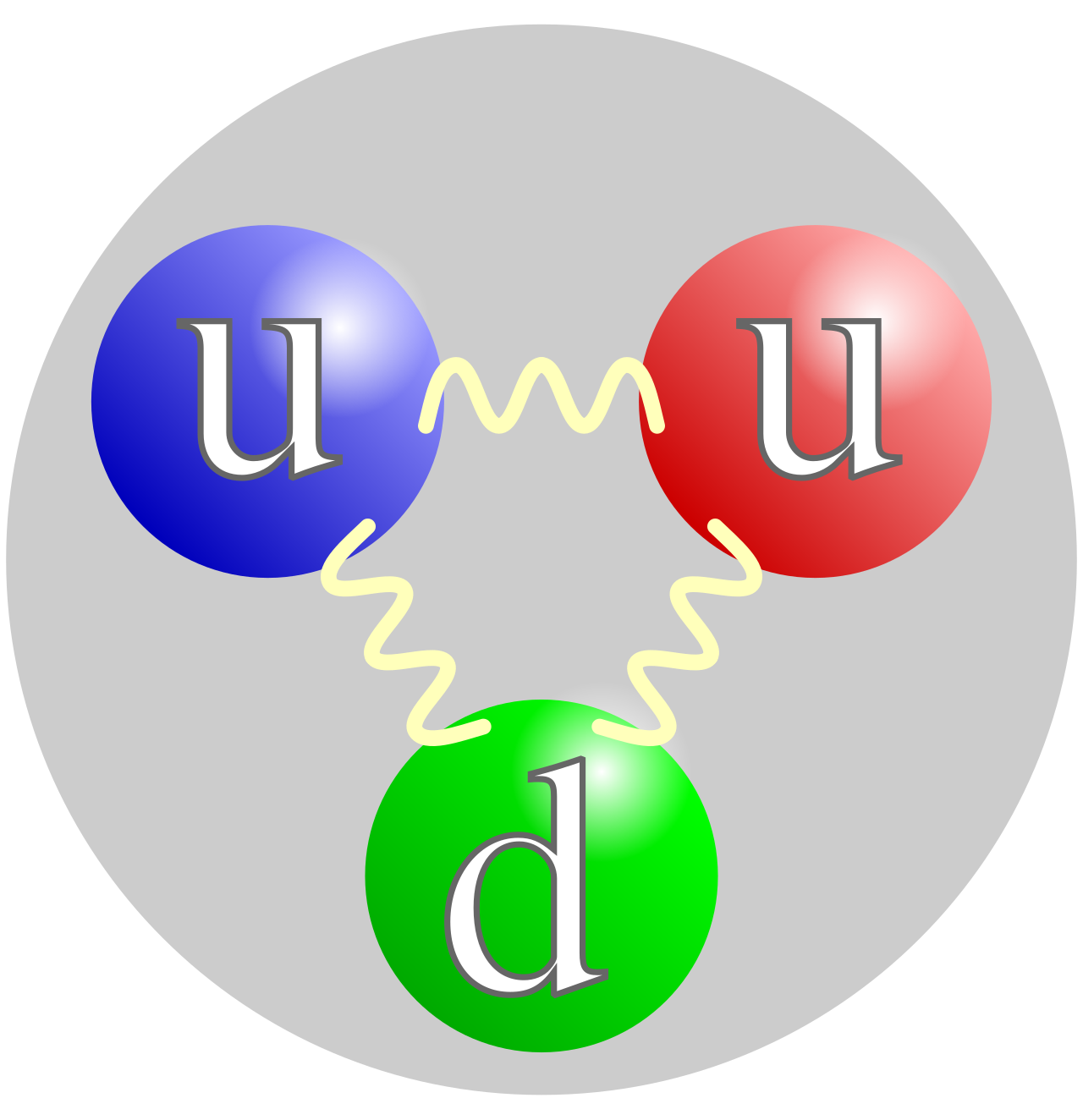
Protons and neutrons, the building blocks of atomic nuclei, are composite particles known as baryons, each made up of three quarks:
- A proton consists of two up quarks and one down quark. Let's verify its charge: (2/3) + (2/3) + (-1/3) = +3/3 = +1. This perfectly matches the known charge of a proton.
- A neutron is composed of one up quark and two down quarks. Its charge can be calculated as: (2/3) + (-1/3) + (-1/3) = 0/3 = 0. This also aligns with the neutron's neutral charge.
These quarks within protons and neutrons are not simply sitting side-by-side; they are held together by an incredibly powerful force known as the strong nuclear force. This force is mediated by other elementary particles called gluons. The strong force is what binds the nucleus together, overcoming the electromagnetic repulsion between positively charged protons.
The Heavier Generations: Beyond the Everyday
While up and down quarks dominate our everyday existence, the other four flavors – charm, strange, top, and bottom – exist primarily in more exotic and less stable forms of matter. These are often referred to as the second and third generations of quarks, being significantly more massive than their up and down counterparts.
- Strange quarks were the first of the heavier quarks to be discovered, identified in cosmic rays during the 1940s. Particles containing strange quarks are called "strange particles" due to their unexpectedly long lifetimes.
- Charm quarks were theoretically predicted and then experimentally confirmed in the 1970s, leading to the "November Revolution" in particle physics.
- The bottom quark, discovered in the late 1970s, is significantly heavier, and its discovery paved the way for the prediction of the top quark.
- The top quark, the heaviest of all elementary particles discovered to date, was finally observed in 1995. Its immense mass provides important insights into the fundamental parameters of the Standard Model.
These heavier quarks are unstable and decay very rapidly into lighter quarks through the weak nuclear force. This is why we don't find them in stable atomic nuclei; they only appear in high-energy particle accelerators or during events like cosmic ray interactions, offering physicists a window into the more extreme conditions of the early universe.
Color Confinement: Why Quarks are Never Alone
One of the most profound and peculiar aspects of quarks is a phenomenon known as color confinement. Unlike electrons or photons, which can exist as isolated particles, quarks are never found in isolation. They are always confined within composite particles called hadrons. This is a crucial concept when we endeavor to define quark in its full context.
To understand color confinement, we must introduce another quantum property: "color charge." This isn't literal color, but an analogy to the primary colors (red, green, blue) to describe a type of charge that quarks carry, which is different from electric charge. Just as opposite electric charges attract, different color charges interact via the strong nuclear force, mediated by gluons.
Hadrons are "color-neutral" (or "white"), meaning their constituent quarks combine in specific ways to cancel out their color charges. There are two main types of hadrons:
- Baryons: Composed of three quarks, like protons (up, up, down) and neutrons (up, down, down). In baryons, one quark of each "color" (red, green, blue) combines to form a color-neutral state.
- Mesons: Composed of a quark-antiquark pair. For example, a pion might consist of an up quark and an anti-down quark. Here, a color and its corresponding anti-color combine to form a color-neutral state.
The strong force binding quarks together is unique: it doesn't weaken with distance like electromagnetism or gravity. Instead, the force actually increases as you try to pull quarks apart. Imagine trying to stretch a rubber band that gets stronger the more you stretch it. If you try to separate a quark from its hadron, the energy required eventually becomes so immense that it's more energetically favorable to create new quark-antiquark pairs from the vacuum, which then form new hadrons. This means you never get a lone quark; you only ever get new bursts of hadrons. This fascinating phenomenon is The Mystery of Quarks: Why They're Never Found in Isolation, and it's a testament to the immense power of the strong nuclear force.
Unveiling the Invisible: Experimental Confirmation of Quarks
Given that quarks are never observed directly due to color confinement, how can scientists be so sure of their existence? The journey from hypothesis to widely accepted scientific fact involved ingenious experiments and careful interpretation of data.
The pivotal evidence for quarks came from a series of "deep inelastic scattering" experiments conducted at the Stanford Linear Accelerator Center (SLAC) in the late 1960s and early 1970s. In these experiments, high-energy electrons were fired at protons and neutrons. If protons and neutrons were truly fundamental, the electrons would scatter off them in a predictable, uniform way. However, the experimental results showed that the electrons were scattering off tiny, hard, point-like constituents within the protons and neutrons.
Richard Feynman famously called these constituents "partons," a general term for point-like particles inside hadrons. Over time, as more precise data emerged and theoretical predictions aligned with observations, these partons were identified as the quarks theorized earlier by Murray Gell-Mann and George Zweig. The fractional electric charges of these internal constituents were also experimentally verified, matching the +2/3 and -1/3 predictions for quarks.
These experiments provided irrefutable indirect evidence for the existence of quarks, much like observing ripples in a pond reveals the presence of an unseen stone dropped into it. The discovery marked a profound shift in physics, moving from a view of protons and neutrons as fundamental particles to understanding them as composites of even smaller, truly fundamental particles.
Beyond the Definition: The Ongoing Significance of Quarks
The name "quark" itself has an interesting origin, coined by physicist Murray Gell-Mann, inspired by a line in James Joyce's novel "Finnegans Wake": "Three quarks for Muster Mark!" This whimsical name belies the profound impact these particles have had on our understanding of the universe.
Quarks are not just abstract theoretical constructs; they are the very essence of stability for everyday matter. Without the strong force binding quarks into protons and neutrons, and without these specific combinations of up and down quarks, the nuclei of atoms would not form, and the cosmos as we know it would not exist. Understanding quarks is key to understanding nucleosynthesis in the early universe, the structure of neutron stars, and the behavior of matter under extreme conditions.
The study of quarks continues to be a vibrant field of research in particle physics. While the Standard Model has been incredibly successful in describing quarks and their interactions, mysteries remain. For instance, why are there three generations of quarks? What is the origin of their vastly different masses? Exploring these questions pushes the boundaries of human knowledge and could lead to new physics beyond the Standard Model.
Conclusion
In summary, to define quark is to acknowledge it as an elementary particle and a fundamental constituent of matter, responsible for building protons and neutrons, which in turn form the nuclei of all atoms. With six distinct flavors – up, down, charm, strange, top, and bottom – each carrying fractional electric charges, quarks are unique in the subatomic world. The pervasive phenomenon of color confinement ensures they are never found in isolation, always bound within hadrons by the incredibly powerful strong nuclear force mediated by gluons. While unobservable directly, their existence has been unequivocally confirmed through pioneering experiments, cementing their role as critical components of the Standard Model and revolutionizing our comprehension of the universe's most basic building blocks. The ongoing study of these elusive particles continues to unlock deeper insights into the fundamental forces that govern reality.