What is a Quark? The Elementary Building Block of Matter
At the very heart of matter, far beyond the reach of conventional microscopes and even smaller than atoms, lie the enigmatic particles known as quarks. To
define quark is to step into the fascinating realm of particle physics, where the ultimate building blocks of the universe are explored. A quark is, by its most fundamental definition, an
elementary particle and a fundamental constituent of matter. Unlike larger, composite particles like protons and neutrons, quarks are currently believed to be truly indivisible – they are not made up of any smaller known particles.
These minuscule entities form the bedrock upon which the more familiar subatomic particles, particularly protons and neutrons (which in turn compose atomic nuclei), are built. The theoretical prediction of their existence, and subsequent experimental confirmations, revolutionized our understanding of the atomic nucleus and the forces that govern it. Prior to the quark model, protons and neutrons were thought to be fundamental themselves. The discovery that these crucial components of an atom possess substructure offered a profound shift in perspective, offering a deeper, more elegant explanation for the diverse array of particles observed in high-energy experiments.
While the term "quark" can also refer to a type of fresh, unripened cheese, our focus here is squarely on the groundbreaking physics concept that reshaped modern science. The journey to precisely
define quark takes us through a world of fractional charges, peculiar "colors," and forces unlike anything experienced in daily life.
The Six Flavors of Quarks and Their Distinct Properties
The Standard Model of particle physics, our most successful and comprehensive theory describing the fundamental particles and forces of the universe, identifies six distinct types, or 'flavors,' of quarks. Each of these flavors possesses unique properties, including mass and electric charge, contributing to the rich tapestry of matter.
The six quark flavors are:
- Up (u)
- Down (d)
- Strange (s)
- Charm (c)
- Bottom (b)
- Top (t)
A defining characteristic of quarks is their electric charge, which is unlike that of electrons or protons. Instead of being whole integer multiples of the elementary charge (e), quark charges are quantized in fractions: +2/3e or -1/3e. Specifically:
- Up, Charm, and Top quarks carry an electric charge of +2/3e.
- Down, Strange, and Bottom quarks carry an electric charge of -1/3e.
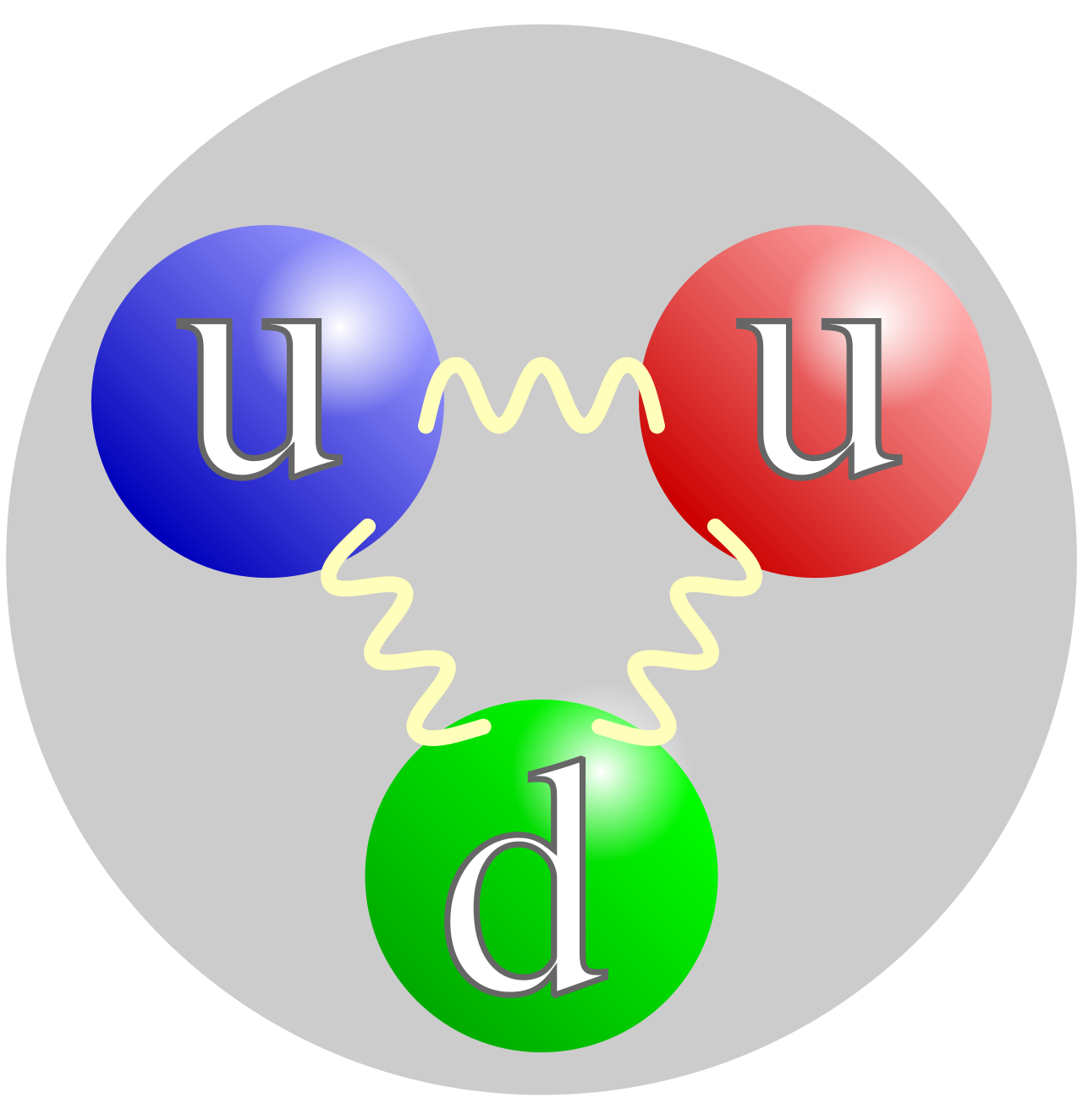
Among these, the 'up' and 'down' quarks are the lightest and most stable, making them the primary constituents of all ordinary, observable matter. They are the building blocks of protons and neutrons. For instance, a proton is composed of two up quarks and one down quark (uud), resulting in a net charge of (+2/3 + 2/3 - 1/3)e = +1e. A neutron, on the other hand, consists of one up quark and two down quarks (udd), yielding a net charge of (+2/3 - 1/3 - 1/3)e = 0. This elegant arrangement neatly explains the charges of these fundamental atomic components.
Each quark flavor also has a corresponding antimatter counterpart, known as an
antiquark. An antiquark possesses the same mass as its quark twin but carries an opposite electric charge and other quantum numbers. For example, an anti-up quark has a charge of -2/3e. Understanding these distinct flavors and their fractional charges is absolutely key to grasping how fundamental particles combine to create the diverse array of matter we observe. To delve deeper into how these various quark flavors build up the universe's familiar components, explore our detailed article on
Quarks Explained: From Six Flavors to Protons and Neutrons.
The Enigma of Color Confinement: Why Quarks Are Never Alone
One of the most fascinating, and perhaps initially perplexing, aspects when we attempt to truly
define quark is their inability to exist in isolation. Unlike other charged elementary particles, such as electrons, which can be observed and studied freely, quarks are perpetually bound within composite particles called hadrons. This profound phenomenon is known as
color confinement.
Color confinement arises from the unique nature of the strong nuclear force, one of the four fundamental forces of nature. Quarks possess a property called 'color charge' – a quantum property that, despite its name, has no relation to visual color. Instead, it's an abstract label used to describe how quarks interact via the strong force. There are three 'colors' assigned to quarks (red, green, and blue), and antiquarks possess corresponding 'anticolors' (anti-red, anti-green, and anti-blue).
The principle of color confinement dictates that quarks must always combine in 'color-neutral' (or 'white') configurations. This means:
- Baryons: Particles like protons and neutrons are composed of three quarks, one of each color (red, green, blue), which combine to form a 'white' or color-neutral state.
- Mesons: These particles are composed of a quark and an antiquark, where the antiquark's anticolor neutralizes the quark's color (e.g., a red quark and an anti-red antiquark).
The strong force itself is mediated by particles called
gluons. Unlike the electromagnetic force, which weakens with distance, the strong force between quarks actually gets *stronger* as you try to pull them apart. Imagine trying to stretch an incredibly strong rubber band; the more you stretch it, the harder it pulls back. In the case of quarks, if you try to separate them, the energy required to overcome this increasing force becomes so immense that it's more energetically favorable for new quark-antiquark pairs to spontaneously emerge from the vacuum, forming new hadrons. This effectively prevents any single quark from ever being isolated.
This means that while individual quarks have never been directly observed as free entities, their existence and properties are inferred through meticulous experimental data. High-energy collisions in particle accelerators produce "jets" of hadrons that are consistent with the theoretical predictions of underlying quark and gluon interactions, providing strong experimental confirmation of their reality. The groundbreaking theoretical predictions based on their existence have been consistently confirmed, solidifying their place in the Standard Model. This mysterious aspect of their existence, and the profound implications of color confinement, are further explored in
The Mystery of Quarks: Why They're Never Found in Isolation.
Quarks in the Fabric of Reality: Impact and Implications
The theoretical postulation and subsequent experimental validation of quarks irrevocably changed our understanding of matter and the fundamental forces that govern the universe. Before the quark model gained acceptance, protons and neutrons were considered the most fundamental building blocks of the atomic nucleus. The revelation of their substructure opened a new, deeper layer of reality, offering a unified and elegant explanation for the vast menagerie of subatomic particles discovered in particle accelerators.
Understanding how to
define quark is not merely an academic exercise; it's a critical component in deciphering the fundamental laws of nature with far-reaching implications:
Key Impacts and Insights:
- Unified Theory of Matter: Quarks are integral to the Standard Model of particle physics, providing a consistent framework for understanding the strong nuclear force and the internal composition of atomic nuclei. This model accurately predicts and explains the behavior of virtually all known particles and forces.
- Understanding Mass: Intriguingly, much of a proton's mass (and thus, much of the mass of all ordinary matter) doesn't come directly from the tiny masses of its constituent quarks. Instead, it arises primarily from the immense energy of the gluons and the kinetic energy of the quarks rattling around inside the proton, a profound demonstration of Einstein's mass-energy equivalence (E=mc²).
- Cosmological Insights: Knowledge of quarks is vital for studying the very early universe. In the first microseconds after the Big Bang, temperatures and densities were so extreme that quarks and gluons existed in a freely moving state known as a 'quark-gluon plasma,' much like a hot, dense soup, before cooling sufficiently to bind together into protons and neutrons.
- Technological Advancement: The ambitious particle accelerators and detectors built to probe these fundamental particles drive significant technological innovation. Advances in superconducting magnets, ultra-precise detectors, advanced computing, and data processing techniques often find applications far beyond particle physics.
- Pushing the Boundaries of Knowledge: The ongoing study of quarks, their interactions, and the search for phenomena beyond the Standard Model (such as new quarks or other fundamental particles) continues to push the boundaries of human knowledge, addressing some of the deepest questions about the universe's origin and nature.
Conclusion
In summary, to
define quark is to identify a truly fundamental particle – an elementary constituent of matter that forms the very core of protons and neutrons. Despite their elusive nature, never observed in isolation due to the phenomenon of color confinement, the six distinct flavors of quarks (up, down, strange, charm, bottom, and top), along with their antiquarks, underpin the structure of all ordinary matter and are central to the Standard Model of particle physics. Their fractional electric charges, unique color property, and the incredibly strong force that binds them together offer a profound and elegant explanation for the stability and diversity of the atomic nucleus. The discovery and ongoing study of quarks continue to push the boundaries of human knowledge, offering unparalleled insights into the ultimate building blocks of the universe and the fundamental forces that govern them, cementing their role as one of the most critical concepts in modern physics.